Welcome to
BEST
IN
SHOW
Connect with thousands of animal enthusiasts, share your experiences, and explore a world of pets and professionals.
It’s free to join!
Already have an account? Log in
At first glance, the Vogelkop Gardener bowerbird is pretty boring. Its drab olive-brown plumage makes it hard to spot against the dirt on which it lives. However, a closer look reveals that this otherwise dull bird has a secret: the males build some of the most elaborate, aesthetically-pleasing objects of any bird.
Bowers are decorated structures that the males build to woo females. In some places they're tall towers made of sticks resting upon a round mat of dead black moss, decorated with snail shells, acorns, and stones. In other places, they're woven towers built upon a platform of green moss, adorned with fruits, flowers, and severed butterfly wings. Individual Vogelkop bowerbirds have their own tastes, preferring certain colours to others. The males place each item in their bowers with great precision; if the objects are moved, the birds return them to the original arrangement.
"Decorating decisions are not automatic but involved trials and 'changes of mind,'" wrote UCLA physiologist Jared Diamond, one of the first researchers to intensively study the birds' complex bowers. Diamond discovered that bower building was not innate, at least not entirely. The younger birds had to learn how to build the best bowers, either through trial and error, or by watching more experienced birds, or both.
Diamond concluded that bower building was a culturally transmitted creative process where each bird had his or her own individual tastes and preferences, and where each decision was made with intention and care. Bowerbirds, in other words, are animal artists – at least in sense that they take care in producing unique works that humans and birds alike find aesthetically pleasing.
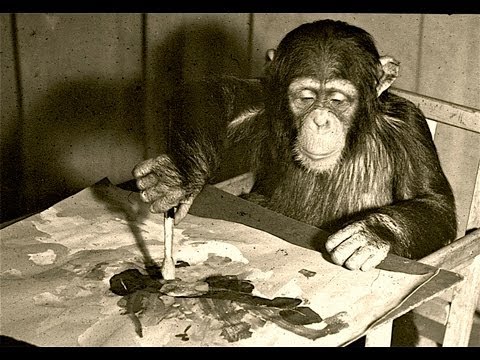
Bowerbirds aren't the only non-human artists. Congo was a male chimpanzee born in 1954 at London Zoo. When Congo was two years old, the British zoologist and artist Desmond Morris gave the chimp a pencil. "He took it and I placed a piece of card in front of him," Morris told The Telegraph in 2005. "Something strange was coming out of the end of the pencil. It was Congo's first line. It wandered a short way and then stopped. Would it happen again? Yes, it did, and again and again." Congo eventually graduated from pencils to paintbrushes. He and his art were featured on the British television programme Zoo Time, and in 1957 the Institute of Contemporary Arts featured his work in an exhibition.
While he never painted identifiable images – no portraits, no landscapes, no still lifes – Congo's style was unironically described by some as "lyrical abstract impressionism". He seemed to have a sense of intention in his paintings, and a sense of coherence. If his paintings or brushes were taken away before he felt he was done, he whined until they were returned to him. If he had completed his work, he refused to continue painting even at Morris's prompting.
In 2005, a set of three paintings by Congo, who created more than 400 works in his lifetime, were sold at auction for £14,400. In the same auction, an Andy Warhol painting and a Renoir sculpture went unsold.
Congo may have once been a zoological curiosity, a rare primate who was given the unique opportunity to express his artistic desires – or at least to smear graphite and paint onto a flat surface. But in the decades since he produced his first drawing, zoos have been giving paintbrushes to animals as a common practice. The hope is that these attempts at creative expression help keep animals happy.
While putting paintbrush to canvas isn't by any means a natural activity for a chimpanzee, elephant, or any other non-human animal, it is thought to help introduce some novelty into the lives of those animals. Painting is an activity through which the animals can exercise their minds, instead of just their bodies – “enriching” the otherwise boring captive environment.


Celeste de Breze
10 years, 8 months ago
Celeste de Breze added a video to Animals and Art.
Art by Animals
Celeste de Breze
10 years, 8 months ago
Celeste de Breze added a photo to Animals and Art.

A few animals are prodigious producers of ‘art’, says Jason G Goldman. Why do they do it Do they enjoy the creative process And is their work any good
Celeste de Breze
10 years, 8 months ago
Celeste de Breze added a photo to Animals and Art.

A few animals are prodigious producers of ‘art’, says Jason G Goldman. Why do they do it Do they enjoy the creative process And is their work any good
Celeste de Breze
10 years, 8 months ago
Celeste de Breze added a photo to Animals and Art.

In order 1. Elephant 2. Sumatran Orangutan 3. Chimp 4. Gorilla 5. Elephant 6. Human being
Celeste de Breze
10 years, 8 months ago
Celeste de Breze added a photo to Animals and Art.

In order 1. Elephant 2. Sumatran Orangutan 3. Chimp 4. Gorilla 5. Elephant 6. Human being
Celeste de Breze
10 years, 8 months ago
Celeste de Breze added a photo to Animals and Art.

In order 1. Elephant 2. Sumatran Orangutan 3. Chimp 4. Gorilla 5. Elephant 6. Human being
Celeste de Breze
10 years, 8 months ago
Celeste de Breze added a photo to Animals and Art.

A few animals are prodigious producers of ‘art’, says Jason G Goldman. Why do they do it Do they enjoy the creative process And is their work any good
Celeste de Breze
10 years, 8 months ago
Celeste de Breze added a photo to Animals and Art.

In order 1. Elephant 2. Sumatran Orangutan 3. Chimp 4. Gorilla 5. Elephant 6. Human being
Celeste de Breze
10 years, 8 months ago
Celeste de Breze added a photo to Animals and Art.

In order 1. Elephant 2. Sumatran Orangutan 3. Chimp 4. Gorilla 5. Elephant 6. Human being
Celeste de Breze
10 years, 8 months ago
Celeste de Breze added a photo to Animals and Art.

In order 1. Elephant 2. Sumatran Orangutan 3. Chimp 4. Gorilla 5. Elephant 6. Human being
Celeste de Breze
10 years, 8 months ago
Celeste de Breze added a photo to Animals and Art.

A few animals are prodigious producers of ‘art’, says Jason G Goldman. Why do they do it Do they enjoy the creative process And is their work any good
Photos


